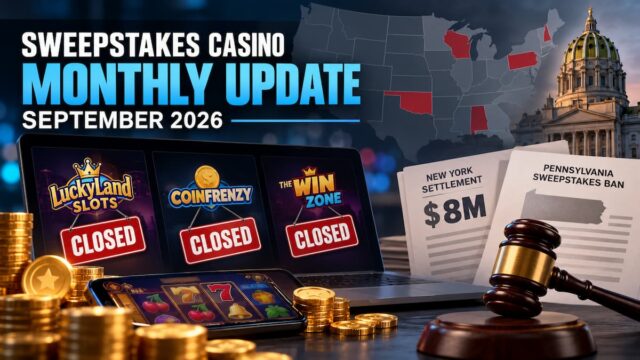
September experienced minimal shifts in the availability of sweepstakes casinos, with three platforms either completing or initiating shutdowns amid ongoing legal and regulatory scrutiny.
Following a summer characterized by numerous state withdrawals, the month of September saw a deceleration in changes, primarily involving a few restrictions and adjustments limited to Gold Coin-only operations.
Several operators made modifications to their lists of restricted jurisdictions, including postponed exits from Indiana and Maine, along with some changes in Oklahoma in anticipation of its prohibition set for November 1.
More significant developments occurred elsewhere. LuckyLand Slots and CoinFrenzy finalized previously announced closures, while The Win Zone initiated a phased shutdown. Additionally, VGW reached an $8 million settlement in New York, and Pennsylvania introduced a comprehensive gaming bill aimed at banning online sweepstakes casinos.
Limited State Restrictions on Sweepstakes Casinos
After extensive withdrawals from states like Indiana, Maine, and Iowa during June and July, September brought relatively few alterations.
Notable changes during September included:
- Pulsz and Pulsz Bingo transitioned Maine from fully restricted to Gold Coin-only, while adding Oklahoma as a Gold Coin-only jurisdiction and removing Mississippi from their Gold Coin-only list.
- Speed Sweeps, Rich Sweeps, and Sweeps Royal included Maine as a Gold Coin-only jurisdiction.
- Sixty6 and Sweeps Jungle added Indiana and Tennessee to their restricted areas.
- Jefebet placed Maine and Iowa on its restricted list, reversing an earlier update that had reopened Iowa.
- Scrooge Casino restricted Indiana and Maine.
- Lucky Rush added Indiana, Maine, and Oklahoma to its restricted jurisdictions.
These additions indicate that some operators are still adapting to recent legislative changes, with Indiana's prohibition effective from July 1, Maine's from July 29, and Louisiana's from August 1.
Shutdowns of LuckyLand Slots and CoinFrenzy
September also marked the completion of two previously announced shutdowns.
VGW’s LuckyLand Slots permanently closed its doors on September 14 after a gradual winding down. This closure does not impact VGW’s other offerings, including the LuckyLand Casino social gaming product or its brands, Chumba Casino and Global Poker.
CoinFrenzy ceased operations after September 7, having initially set a September 25 deadline but advancing it to September 7 during August.
Furthermore, The Win Zone became the latest platform to begin a phased closure, halting purchases on September 22 and ending gameplay on September 24. Customers have until October 23 to submit eligible redemption requests.
These developments are part of a broader trend of contraction within the sector, with around a dozen sweepstakes casinos shutting down in recent months, including the recent closures of Sweep Next, The Money Factory, and LuckyStake.
Continued Legal and Regulatory Challenges
Despite the relatively slow pace of exits and eligibility changes, the sector continues to face significant legal and regulatory pressures.
On September 9, New York Attorney General Letitia James announced an $8 million settlement with VGW following an investigation into Chumba Casino, Global Poker, and LuckyLand Slots. This agreement includes disgorgement, restitution, penalties, and costs, although VGW emphasized that it does not admit liability and noted that it had already ceased offering Sweeps Coin play in New York as of 2025.
Florida Attorney General James Uthmeier has also expanded his state’s crackdown on sweepstakes casinos, targeting not only operators and payment processors but also major tech companies. Following lawsuits against Stake and VGW in August, Uthmeier sent letters to Google, Meta, Reddit, Snap, and TikTok regarding advertisements for sweepstakes casinos directed at Florida residents. These companies have until October 23 to respond with details of their preventative measures against such advertising.
Pennsylvania has emerged as a state to watch after Representative Russ Diamond introduced HB 2801 on September 24, which is part of a broader gaming initiative.