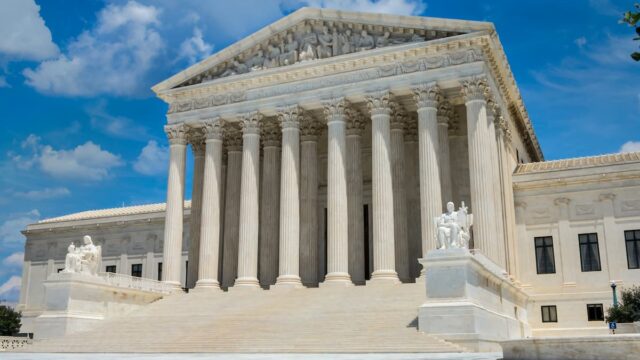
The National Football League (NFL) has joined a coalition of industry stakeholders urging the U.S. Supreme Court to review New Jersey’s legal challenge against Kalshi, a prediction market operator. The case centers on whether states have the authority to regulate sports prediction markets, and comes as other organizations, including the American Gaming Association (AGA), 145 tribal governments and organizations, and two former federal officials, have also called for Supreme Court intervention.
Industry Concerns Over Regulation and Integrity
The NFL’s recent amicus brief expressed concerns about the ability of the Commodity Futures Trading Commission (CFTC) to adequately enforce regulations, especially given its limited staffing compared to state gaming regulators. The league highlighted risks such as contract manipulation and the lower age requirement for prediction market participation compared to traditional sports betting. The AGA argued that prediction markets may bypass state-level taxation and consumer protection standards, while tribal organizations warned that sports event contracts could threaten tribal sovereignty and revenue streams. These groups also questioned whether federal law should supersede existing tribal gaming agreements.
Legal Arguments and Federal Oversight
Former Senator Christopher Dodd and former CFTC Chair Gary Gensler also filed briefs challenging Kalshi’s interpretation of federal law. Both emphasized that Congress did not intend for the CFTC to oversee sports betting, nor did it seek to redefine sports wagers as financial derivatives. Their arguments reinforce the view that states and tribes should retain primary responsibility for gaming regulation.
Seminole Tribe Lawsuit Targets DraftKings
In a related development, the Seminole Tribe of Florida has sued DraftKings, alleging that the company’s Pick6 product and related sports-event contracts function as unlicensed sportsbooks in violation of the state’s gaming compact. The Tribe claims these products mimic traditional sports wagering and are being offered in jurisdictions where DraftKings lacks a sports betting license. The complaint seeks an injunction, disgorgement of profits, and legal costs.
Why This Matters for the Industry
The Supreme Court’s eventual decision could have far-reaching implications for operators, affiliates, and suppliers. If prediction markets are found to fall under federal jurisdiction, it could reshape how sports betting products are regulated and taxed, and potentially create new compliance challenges. For tribal operators, the outcome could impact exclusivity agreements and revenue streams. The ongoing legal uncertainty also raises questions about the future role of the CFTC and state regulators in overseeing emerging wagering products.
Key takeaways
- The NFL and other major stakeholders are urging the Supreme Court to review the Kalshi prediction market case.
- Industry groups cite concerns about regulatory oversight, game integrity, and tribal sovereignty.
- The Seminole Tribe has filed suit against DraftKings over alleged unlicensed sports betting in Florida.
- The outcome could significantly affect regulatory responsibilities and market access for operators and affiliates.
Update (09.10.2026)
On October 2, the International Association of Gaming Regulators (IAGR) and the North American Gaming Regulators Association (NAGRA) jointly filed an amicus brief in Flaherty v. KalshiEX, supporting New Jersey's Supreme Court petition. Gaming attorney Daniel Wallach estimates a Supreme Court decision could come by June 2027. Recent appellate decisions have varied: the Third Circuit ruled for Kalshi in April, while the Sixth and Ninth Circuits favored state enforcement, with the Sixth Circuit upholding Ohio's denial of an injunction and vacating Tennessee's, and the Ninth Circuit affirming Nevada's authority and dissolving Kalshi's protection. The Fourth Circuit heard Maryland's case in May, and New York's appeal is still pending. The IAGR and NAGRA brief warns that more circuit decisions will only increase legal inconsistency, and highlights the challenges tribal regulators face, referencing a September Ninth Circuit finding that unauthorized sports contracts on tribal lands likely violate the Indian Gaming Regulatory Act (IGRA).