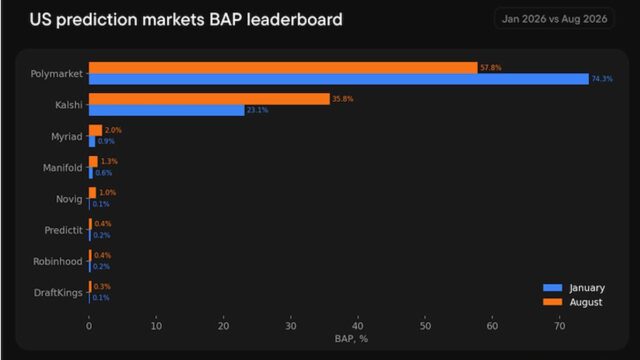
Recent data from Blask reveals a notable disparity between brand visibility and trading activity in the prediction market sector. While Kalshi has significantly increased its trading volume, Polymarket still garners more attention in branded searches.
Blask's analysis, which tracked search interest in prediction markets from January to August 2026, indicates that Polymarket maintained the largest share of branded search demand, as determined by its Brand’s Accumulated Power (BAP). However, Kalshi has made impressive strides in closing the gap.
Throughout this period, Polymarket experienced a decline in BAP, dropping from 74.3% to 57.8%, a loss of 16.56 percentage points. In contrast, Kalshi saw an increase in its BAP from 23.1% to 35.8%, gaining 12.7 points. Overall, the combined market share of the two companies decreased from 97.4% to 93.6%. Notably, among smaller competitors, Novig recorded the most significant growth in the Blask Index, with a 64.9% increase from January to July.
When examining trading volumes, the figures tell a different story. In August, Kalshi reported a staggering $37.17 billion in trading volume, while Polymarket and Polymarket US together accounted for only $8.16 billion, as per The Block.
Blask emphasizes that these contrasting figures highlight the different metrics being measured. The BAP metric reflects the share of branded search interest—essentially how many people are searching for the brand—rather than the volume of matched trades or notional amounts. According to Blask, Polymarket's advantage stems mainly from its established brand recognition, which attracts more search interest per user, even as Kalshi captures a larger share of actual trading volume.
As Blask articulated, “Trading volume is a liquidity/execution metric; BAP is an attention metric.”
The Blask Index focuses on branded search activity rather than transactions, users, or revenue. The company utilizes geo-tagged search data alongside contextual filtering to isolate searches related to betting or trading, eliminating irrelevant queries. This BAP metric thus measures how search demand is divided among competing brands.
This distinction is crucial when assessing Kalshi's growth trajectory. During the World Cup, Kalshi's BAP surged from 18% in May to 29% in June and 36% in July. Conversely, Polymarket's BAP declined from 80% to 69%, and then to 61%. By August, Kalshi's BAP reached 35.8%, indicating a narrowing gap with Polymarket, which still leads but by a reduced margin compared to earlier in the year.
Kalshi's growth is not solely attributed to Polymarket's decline; its Blask Index rose by 22.8% from January to July, even as the overall prediction market segment shrank by 22%. This suggests that Kalshi is successfully attracting more branded search interest even as the broader market cools.
For operators with multiple products, Blask clarifies that it isolates searches specifically related to prediction markets. This helps explain why brands like DraftKings and FanDuel enjoy significant sportsbook recognition while showing minimal BAP in prediction markets.
In contrast, Kalshi and Polymarket operate solely within the prediction market space, meaning all their branded searches are relevant. The data underscores that record trading volumes do not necessarily correlate with record search demand, as evidenced during the World Cup when Kalshi reported approximately $27 billion in trading volume, although estimates vary based on the activities counted.