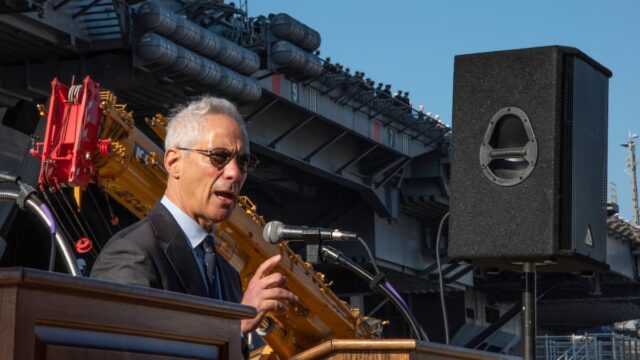
Rahm Emanuel, the former Mayor of Chicago and U.S. Ambassador to Japan, has introduced a plan to implement a 10% federal tax on all forms of online gambling, including prediction markets. This initiative is designed to potentially raise between $30 billion and $50 billion annually, which would be allocated to a new American Innovation Fund aimed at advancing research in critical areas such as artificial intelligence, fusion energy, national security technology, and quantum computing.
Emanuel's proposal is part of a broader strategy to ensure that the United States maintains its competitive edge over China. He acknowledges that for this proposal to become law, it would require Congressional approval, a process that may face significant challenges given the current political climate.
Since concluding his ambassadorship in January 2025, Emanuel has re-engaged in public discourse, presenting various policy suggestions as he positions himself for a possible run in the 2028 presidential race. Currently, California Governor Gavin Newsom is viewed as the frontrunner for the Democratic nomination.
During a recent Wall Street Journal Live event in Washington, D.C., Emanuel elaborated on his tax proposal and also suggested a $25,000 tax credit for first-time homebuyers. He proposed restructuring federal housing agencies like Freddie Mac and Fannie Mae to better assist new homeowners and advocated for raising the federal retirement age from 67 to 75.
When questioned about whether his policy ideas were intended to distinguish him from other Democratic candidates, Emanuel remarked that while that could be a “side benefit,” his primary focus is on ensuring that Americans thrive and that the nation remains competitive.
Emanuel’s approach mirrors historical political strategies that involve taxing vices, such as gambling, to fund public initiatives that enjoy widespread support. He believes that this revenue could be redirected towards national investment goals, thereby reducing political resistance.
He drew parallels between his proposal and existing taxes on alcohol and tobacco, expressing confidence that fellow Democrats would back increased funding for research. Emanuel criticized the previous Trump administration for its cuts to research institutions and its perceived antagonism towards universities, which he argues has inadvertently aided China.
However, if Emanuel’s proposal gains momentum, it is expected to face significant opposition from a well-funded and politically influential gaming industry. Reports indicate that the global online gaming market generated $121 billion in 2025, with projections suggesting it will surpass $123 billion this year. Since the federal ban on sports betting was lifted in 2018, the U.S. legal sports betting market has expanded dramatically, growing from around $2.5 billion to nearly $20 billion in just five years, with expectations to reach $40 billion by 2029.
Emanuel estimates that the online gambling and prediction market sector manages approximately $400 billion in total wagers, not merely revenue. The legal gaming industry possesses the financial resources and motivation to lobby vigorously against a 10% tax on its operations, and it is likely that bipartisan state legislators, tribal gaming operators, and professional sports leagues that have embraced legalized online gambling will join forces in opposition.
This is not the first time a politician has sought to capitalize on the online gambling industry; previous federal attempts have faltered.