SARATOGA SPRINGS, NY – The gambling landscape this year has been dominated by a legal dispute involving federally regulated prediction markets that offer contracts on sports events, with states arguing these platforms operate as illegal sportsbooks.
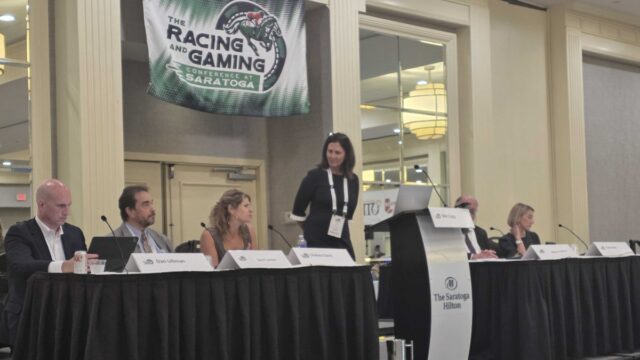
New York is currently at the center of this conflict, as it pursues $36 billion in a lawsuit against Kalshi. This backdrop made it fitting for the recent Racing and Gaming Conference in Saratoga to feature a panel discussion on the matter. This session occurred just a day before Commodity Futures Trading Commission (CFTC) Chairman Michael Selig invoked the agency's “emergency authority” to shield Kalshi from potential legal issues in New York.
Katie Neer, an attorney from Albany-based lobbying firm Dickinson & Avella PLLC, pointed out that several states have either initiated legislation or enacted laws aimed at regulating or taxing prediction market operators. However, she understands why New York has yet to take similar steps.
Having served nearly three years as the state’s assistant secretary for general government and financial services under former Governor Andrew Cuomo, Neer was instrumental in shaping policies and overseeing operations for six state agencies, including the New York State Gaming Commission.
“The likely reason (New York officials) haven’t taxed prediction markets is their desire not to legitimize that activity while significant legal proceedings are ongoing,” she explained. “I believe they should move past that and start capturing tax revenue.”
Prior to the state's lawsuit against Kalshi filed last month, the operator suggested implementing a 6% tax on its trades, estimating it could generate approximately $10 billion in revenue over five years. Nevertheless, Chelsea Davis, the deputy secretary for gaming, cannabis, and alcohol for Governor Kathy Hochul, indicated that the proposal might not have been enticing enough, especially since state-licensed sportsbooks are subject to a hefty 51% tax on their earnings.
Furthermore, she emphasized that the state should refrain from profiting from illegal activities.
“I’m not saying that generating revenue for the state isn’t crucial. I oversee the state’s cannabis, alcohol, and gambling sectors,” she stated. “Our role in regulation is to balance these interests with the public good.”
Davis cited the state’s legalization of marijuana as an example of effective regulation. While there was public support for legalizing recreational use, there’s less enthusiasm for prediction markets, particularly concerning some of the contracts available for trading.
“Some of the most appealing options come with severe societal repercussions and minimal integrity oversight, leading to a significant backlash,” she remarked. “This raises larger questions about our entire gaming regulatory framework, putting other regulated gaming revenues at risk.”
As litigation regarding prediction markets unfolds nationwide, the CFTC continues to propose regulations for trading on these platforms. Dan Ullman, a partner at global law firm Orrick, noted that the federal agency is “hedging its bets” regarding how courts will resolve the issue and is also “stress testing” sports contracts to ensure market integrity and fair trading practices.
“I predict that the U.S. Supreme Court will ultimately make a decision on this matter,” he added.