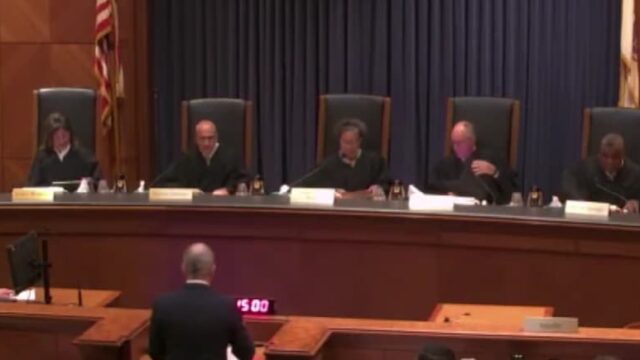
During a recent hearing, judges from the Massachusetts Supreme Judicial Court expressed doubts regarding whether Kalshi's sports event contracts qualify as gambling under state law.
The justices seemed inclined to uphold the state's ability to prohibit the company's contracts, casting skepticism on Kalshi's primary legal arguments.
A key point of contention was whether these contracts differ fundamentally from traditional bets. Justice Gabrielle Wolohojian posed a direct question, asking how Kalshi's contracts are distinguishable from what is commonly understood as betting.
Justice Scott Kafker reinforced this perspective by stating that betting on various commodities is clearly categorized as sports gambling, adding that Kalshi's offerings appear to closely align with this definition.
Kalshi's attorney, Grant Mainland, countered by asserting that the platform functions as a regulated financial exchange rather than a sportsbook, emphasizing that the issue is fundamentally one of federal regulation.
Mainland highlighted the unique aspects of Kalshi's structure, such as user-to-user trading and clearinghouse operations, but judges remained skeptical about whether these features alter the essence of the activity.
Kalshi's argument also hinges on the assertion that the Commodity Futures Trading Commission (CFTC) holds exclusive jurisdiction over event contracts as per the Commodity Exchange Act. However, the justices questioned whether Congress intended to override state gambling regulations.
Kafker remarked that if Congress intended such a significant shift, it would have articulated it more clearly. Justice Dalila Argaez Wendland echoed this sentiment, questioning if exclusive jurisdiction alone could supersede state law.
The court further scrutinized how Kalshi categorizes its contracts under CFTC regulations. Justice Elizabeth N. Dewar expressed confusion over whether the contracts involve gambling, prompting a discussion on CFTC Rule 40.11 and its requirements.
Mainland explained that the rule has two components: whether it involves gaming and whether it contradicts public interest. He noted that regulators have not conducted a formal review of sports event contracts, but the court seemed unconvinced, with Dewar advocating for a more stringent interpretation.