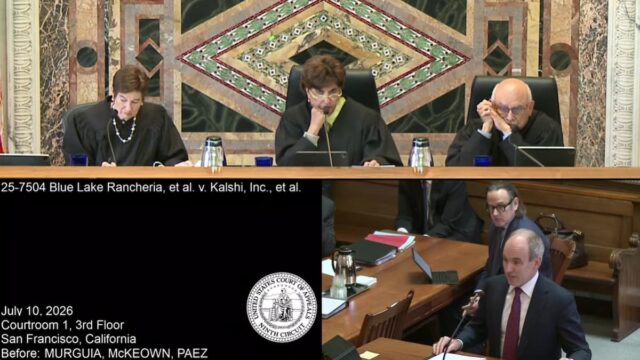
Judges have consistently questioned Kalshi's efforts to differentiate its sports-event contracts from traditional betting as California tribes aim to renew their request for an injunction.
During a hearing on Friday, a panel from the Ninth Circuit compared Kalshi's contracts to standard sports wagers, urging the prediction market operator to clarify why federal law should treat them differently.
This inquiry arose from an appeal by three California tribes—Blue Lake Rancheria, Chicken Ranch Rancheria of Me-Wuk Indians, and Picayune Rancheria of the Chukchansi Indians—who are seeking to revive a preliminary injunction that was previously denied by a federal judge.
The tribes assert that Kalshi's sports-event contracts represent unauthorized Class III gaming on tribal territories, which violates the Indian Gaming Regulatory Act (IGRA) and undermines tribal sovereignty.
A significant portion of the hearing examined whether Kalshi's contracts are substantially different from sportsbook bets. Judge M. Margaret McKeown asked Kalshi's attorney, Grant Mainland, to consider a scenario where someone on tribal land purchases a Kalshi contract that pays out if the San Francisco Giants win, while simultaneously placing a similar wager through DraftKings.
“So, in your view, the first one would be allowed, the Kalshi, but not the DraftKings?” McKeown inquired.
Mainland responded, “Certainly, designated contract markets are regulated differently from regulated sportsbooks.”
As he elaborated, McKeown interjected, confirming, “So the answer is yes.”
Kalshi has maintained its stance that its offerings do not fall under Class III gaming as defined by IGRA. “That is our position. Yes. Not class III gaming,” Mainland stated to the panel.
Judge Richard Paez then addressed the tribes’ claim regarding false advertising under the Lanham Act, highlighting one of Kalshi's ads that states, “sports betting is legal in all 50 states.”
Mainland clarified, “On Kalshi.” However, Paez pressed, “But the question is, what Kalshi is doing. You said it’s not class III gaming. What am I missing?”
Mainland ultimately conceded that trading on whether a team wins has similarities to placing a bet on DraftKings. “Like a bet to me,” Paez remarked.
The tribes contended that even if Kalshi's actions are legal in other jurisdictions, that legality does not extend to tribal lands. Tribal attorney Lester Marston stated, “Let’s just assume that their conduct off the reservation is totally legal. I put to you this: the moment that you take that legal conduct and engage in that exact same conduct on the reservation, they’re committing a crime under 1166, and they’re violating the civil provisions of the IGRA.”
To bolster this argument, Marston referenced the Supreme Court's ruling in United States v. Mazurie, which involved liquor sales rather than gambling. He argued that the decision illustrates how conduct can be lawful outside a reservation but illegal once it takes place on tribal land.
“If it walks like a duck, it quacks like a duck,” he stated, presenting a hypothetical scenario where someone on tribal land downloads the Kalshi app to wager on a World Cup match. “I decide I want to bet on it [World Cup game]. So, I place a bet, right? I put some money up on their app, and whether I am paid money is going to be determined by the outcome of a physical contest, a game.”