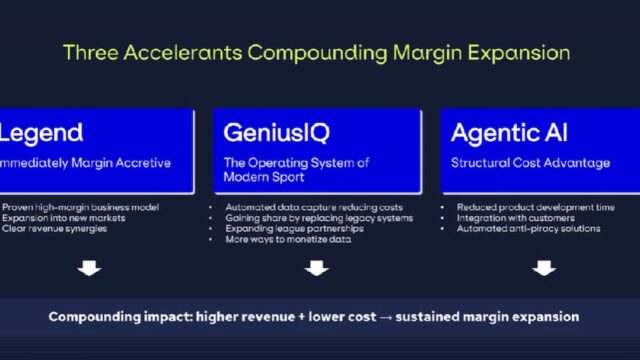
During its Q1 earnings call, Genius Sports revealed a significant strategic transformation, highlighting the importance of prediction markets and the recent acquisition of Legend as pivotal elements for future expansion.
In the call, executives emphasized that Genius Sports is evolving beyond its role as a conventional sports data provider. The company reported a revenue of $188 million for Q1, marking a 31% increase compared to the previous year. Additionally, adjusted EBITDA rose by 21% to reach $24 million. Revenue from Betting Technology, Content & Services saw a notable 33% increase to $146.2 million, while Media Technology revenue grew by 22% to $41.7 million.
Following the completion of the Legend acquisition on May 1, Genius Sports has updated its full-year outlook for 2026. The company now anticipates:
- Revenue between $990 million and $1.01 billion (up from previous estimates of $810 to $820 million)
- Adjusted EBITDA ranging from $270 million to $280 million (previously projected at $180 to $190 million)
- An adjusted EBITDA margin of approximately 28% (increased from 23%)
Executives articulated a shift from being merely a data provider to becoming the foundational operating system and monetization layer for global sports.
Management dedicated a significant portion of the call to discussing prediction markets, which they view as a substantial long-term growth avenue. They characterized these markets as a vital new ecosystem for Genius Sports.
Genius Sports has positioned itself as an infrastructure provider rather than an operator, having onboarded several notable market makers during the quarter utilizing its official low-latency data feeds. Management highlighted that prediction markets present opportunities in areas such as market-making infrastructure and customer acquisition.
CEO Locke drew parallels between prediction markets and the early days of the U.S. online sportsbook market, stating, “We are applying the same proven model in the U.S. online sports betting market to a new category.”
Furthermore, executives indicated that they perceive leading prediction market operators in a similar light to top sportsbook companies regarding revenue potential. Locke mentioned that Genius internally considers firms like Kalshi, Robinhood, and Polymarket as comparable to large sportsbook operators when evaluating market opportunities.
Management also expressed expectations for prediction markets to gradually align more closely with traditional sports betting frameworks. They noted that for these markets to thrive in the long term, collaboration with sports leagues and the Commodity Futures Trading Commission (CFTC) will be essential.
Genius Sports highlighted the increasing significance of official data and league partnerships as the prediction market sector evolves. Recently, several major U.S. sports leagues and players’ associations have approached the CFTC, seeking a more direct role in overseeing event contracts linked to their competitions.
The discussion around the Legend acquisition was another key focus of the call, with executives describing the deal as transformative for Genius’s business model, particularly regarding audience ownership, advertising, and fan engagement.