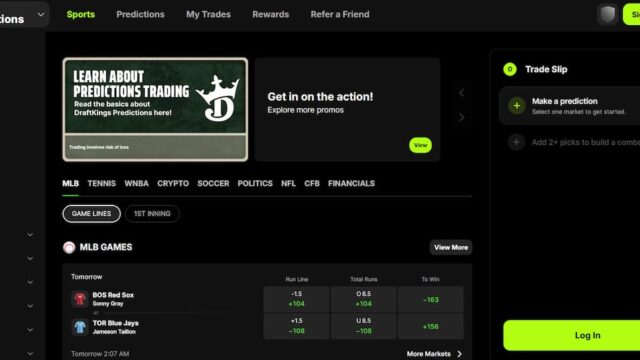
DraftKings has experienced a notable increase in its prediction market volume, which has surged nearly five times since April, even as the company reported a significant decline in profitability during the second quarter of 2026. Management anticipates that customer growth will continue to accelerate with the onset of the NFL season.
In the recent earnings call, CEO Jason Robins disclosed that over 600,000 customers have engaged with DraftKings Prediction this year. He noted that the annualized total volume jumped from $2.3 billion in April to an impressive $11 billion by July.
Robins expressed optimism, stating that the adoption rate has exceeded their expectations, and he expects further growth as DraftKings enhances its offerings in conjunction with the NFL season.
While the focus was on prediction markets, DraftKings reported a 62% year-over-year decline in Adjusted EBITDA, dropping to $114.6 million in Q2, and incurred a net loss of $67.6 million. Revenue also fell by 4.6% to $1.44 billion.
Management attributes the drop in profitability to temporary sports outcomes and an aggressive customer acquisition strategy as they expand their prediction market services nationwide.
DraftKings noted that the annualized prediction market volume rose from $2.3 billion in April to $3.1 billion in May, $9.1 billion in June, and $11 billion in July. More than half of the customers have utilized the newly introduced combo bets, which are similar to parlays, accounting for nearly 20% of consumer volume.
On the day of the earnings announcement, DraftKings’ in-house exchange, DKeX, filed for self-certification of combo offerings, which would allow them to operate independently of third-party exchanges like Crypto.com.
Robins believes the NFL season will act as a significant growth driver, predicting that “millions and millions of customers” will engage with DraftKings Predictions this fall. He anticipates this NFL season to be the largest yet and described customer acquisition costs as “unbelievably efficient.”
He likened the opportunity to launching multiple new sportsbook jurisdictions at once, stating, “It’s like half the country launching at once.”
DraftKings is also finding that its prediction markets allow for more effective advertising, reaching consumers in states without online sports betting, such as California and Texas. This enables the company to maximize its national advertising investments through partnerships with platforms like ESPN and Amazon.
Robins explained, “We’re spending the same dollars, but reaching twice the audience.” This strategy is reflected in their acquisition figures, with customer acquisition rising nearly 75% year-over-year in Q2. The company brought in about 30% more customers than anticipated while increasing acquisition spending by around 10%, yet the underlying customer acquisition costs were approximately 25% lower than expected.
DraftKings also addressed concerns about potential cannibalization from sportsbooks, reinforcing Flutter’s perspective from the second quarter. The company reported only about 1% customer overlap between its sportsbook and the largest prediction-market operator in states with legal online sports betting.
According to their internal analysis, DraftKings estimates that 80% to 90% of the prediction market consumer volume in sportsbook states originates from professional betting syndicates.